
News
Innovative AI glaucoma screening research recognised at Premier’s Awards
A CERA researcher has won a Premier’s Award for Health and Medical Research for her work investigating the impact of artificial intelligence screening tools to detect people at risk of irreversible vision loss from glaucoma.
Dr Catherine Jan received the Health Services Research Award at the 2026 Premier’s Awards for Health and Medical Research, presented by Deputy Premier Ben Carroll.
Dr Jan completed the study in CERA’s Ophthalmic Epidemiology team part of her University of Melbourne PhD investigating how AI could support earlier detection of glaucoma in primary care.
An ongoing study has estimated that national adoption of AI-assisted glaucoma screening could result in significant savings for the Australian healthcare system.
“This recognition is not just mine – it reflects the trust, platform and support I received from CERA and the team,” Dr Jan says.
Glaucoma is the leading cause of irreversible blindness in the world, yet in Australia around 63 out of 100 people living with the condition do not know they have it.
The condition often goes undetected in its early stages due to a lack of noticeable symptoms.
“Early detection is very important because, once we know a person has glaucoma, current treatments can often stop further vision loss,” Dr Jan says.
For most people, a visit to their optometrist or GP is the important first step in getting their eyes checked.
This AI‑assisted screening tool was developed to support primary care clinicians in earlier identification of people at risk of glaucoma, before referral to a specialist for further investigation and treatment.
“The screening tool has been developed to assist the clinician,” Dr Jan says.
“It doesn’t give the final diagnosis because only an eyecare provider can make that call.”
In addition to her CERA colleagues, Dr Jan collaborated with researchers from across Monash and Stanford Universities and was supported by PhD supervisors Professor Mingguang He, Professor Algis Vingrys and Professor Randall Stafford.
Screening in clinics
The research has translated into real‑world settings, with two AI‑enabled screening systems trialled in different types of clinics across Australia.
The first is designed for optometry clinics and works with their existing cameras, which capture detailed images of the light‑sensing retina at the back of the eye.
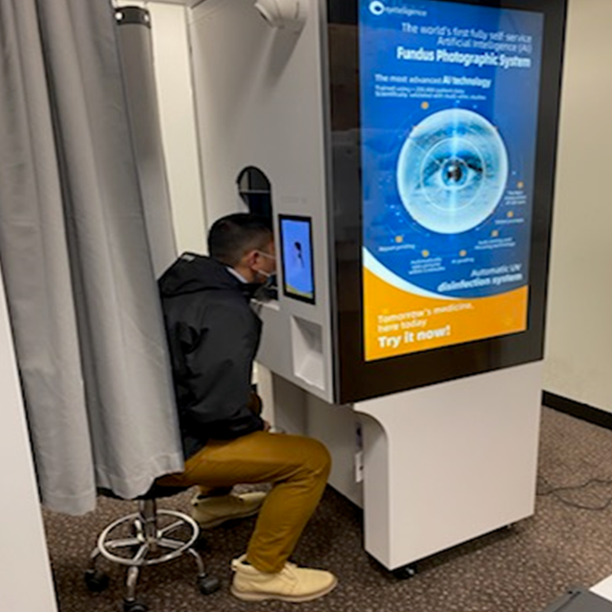
The second is a self‑contained kiosk for GP clinics that uses AI and a built‑in retinal camera. It is the first published AI‑assisted glaucoma screening trial conducted in GP clinics anywhere in the world.
The kiosk uses automated voice instructions to guide patients through the imaging process.
“The patient is advised to place their head on the chin rest, lean forward against the forehead bar and then the camera automatically takes a retinal image,” Dr Jan says.
“Within seconds, it produces a report for the patient as well as for the GP to interpret.”
The report clearly displays results into three categories depending on glaucoma risk. This helps clinicians to decide whether referral to a specialist for further investigation or treatment is needed.
Supporting healthcare
Research results showed that clinicians with AI assistance significantly improved accuracy, consistency and efficiency in glaucoma screening compared to without AI assistance.
“Our ultimate goal is reducing the 63 per cent undiagnosed glaucoma among Australians, so less people suffer from this preventable vision loss,” Dr Jan says.