
Annual Review 2025
Natural wonders
Several long-term research participants – Helmut and Josephine Weigold, Deirdre Casey and Rodney Bayley – have played crucial roles in advancing understanding of how age-related macular degeneration (AMD) progresses.
Listen to this story
Together, they have contributed a combined 38 years with the Macular Research Unit, providing decades of data that have helped drive groundbreaking discoveries to improve outcomes for people with AMD.
Alongside the 5800 participants who have taken part in natural history studies of the condition at CERA since 1997, their contributions have transformed how AMD is understood and treated.
This has included treatments for the wet form of AMD, genetic links associated with the disease, and a greater understanding of risk factors associated with developing the disease.
Helmut and Josephine now think of the team at CERA as family after being involved in AMD research since 2014.
“After my wife Josephine was told she could have AMD by our optometrist, we were inspired to contact the team at CERA,” says Helmut.
Helmut says that they have been involved in various clinical trials – him initially as part of control groups and Josephine as part of treatment groups.
“For Josephine, the team at CERA picked up the very beginnings of bleeding in her retina which indicates wet AMD. This has now progressed to where she can no longer drive, which is a loss of freedom for her,” says Helmut.
CERA has contributed to changing the future for people diagnosed with wet AMD. The first industry sponsored clinical trial conducted in the Macular Research Unit tested a first drug treatment for the condition.
After that initial study, others followed that led to the eventual approval of a drug that was transformative for patients who previously had no effective treatment options.
But for both Helmut and Josephine, being involved in AMD research is about helping others.
“We know that this research is important to help others. We have lost count of how many times we’ve participated, but we are always glad we do and always feel like we’re part of something bigger than ourselves.”
Deputy Director and Head of Macular Research Professor Robyn Guymer AM says people like Helmut and Josephine make better treatments possible.
“The time, generosity and willingness to participate in research is what makes it possible for us to study AMD, how it progresses and test new treatments,” Professor Guymer says.
“The many people who have participated in research, particularly those who have come back year after year, have helped transform how the condition is managed for thousands all over the world.”
Benefits for all
Deirdre Casey, who also has AMD, feels the same as Helmut after being involved in CERA’s research for close to 20 years.
“My grandmother was blind, and my mother had sight issues. When my sister was diagnosed with wet AMD in 2005, I asked an ophthalmologist friend who I should see and he said Robyn Guymer – at that stage not even a professor,” says Deirdre.
“Early on, Robyn asked if I would be interested in joining a clinical trial.”
Deirdre has been involved with AMD research since then, and her late husband was also involved. He was a scientist and they both felt that supporting research was very important.
“From research comes improvement and benefits for all.”
The technology used to monitor the condition has contributed to research.
OCT imaging provides a detailed view of the retina, enabling researchers to track disease progression.
Over the last 30 years these devices have gone from a groundbreaking invention offering an unprecedented view of the eye, to a standard tool of optometry, ophthalmology and research.
The device is fundamental to AMD research at CERA.
Deirdre continues to be excited to be involved in AMD research after all these years.
“It’s so crucial, necessary and interesting,” she says.
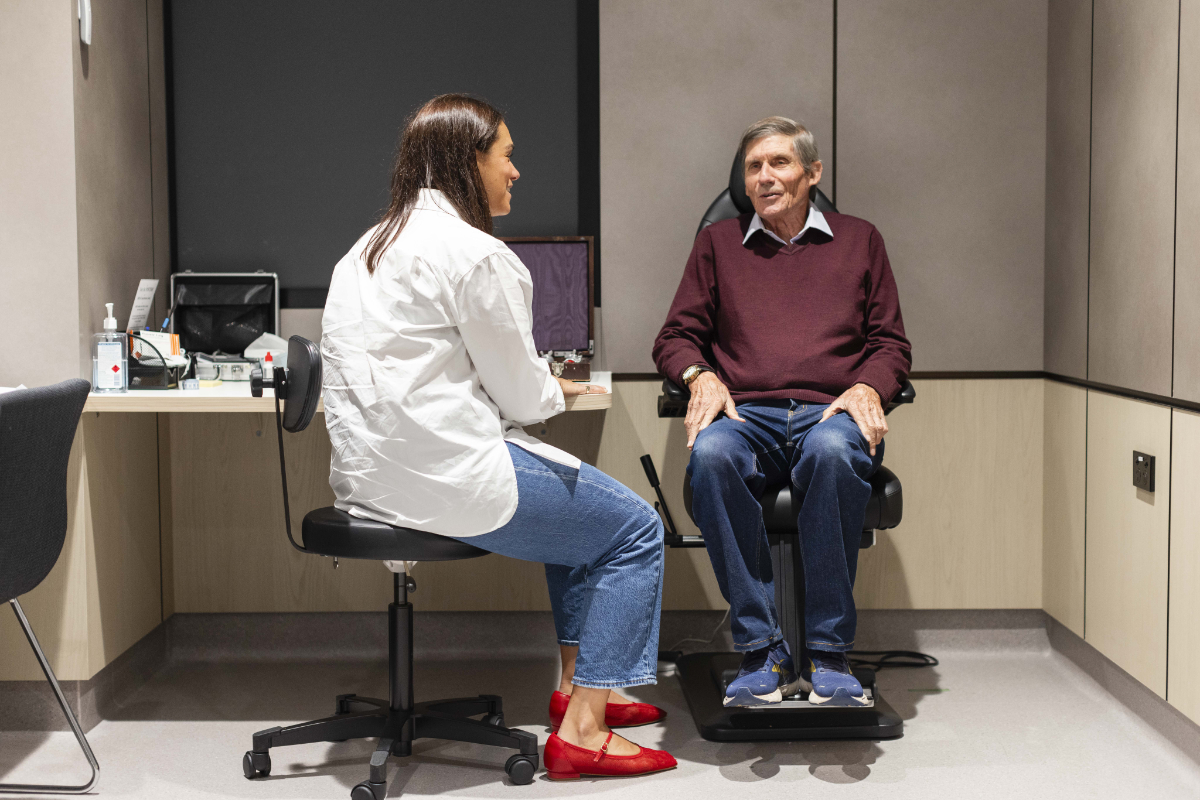
Rodney has been involved in AMD research for six years. After being diagnosed, his doctor suggested he might like to get involved in research trials.
“I decided to get involved, not for treatment, but to help others,” says Rodney.
“What I love about being involved is the sense of community – coming in to see everyone. They always ask: ‘how’s your little granddaughter?’
“I remember when I started getting
involved that we were rejoicing with now Senior Trial Coordinator Emily Caruso, that I was going to have a grandchild, and then Emily excitedly said to us, ‘I’m pregnant too’.
“All of a sudden we were hugging each other,” he says.
In 2025, the earliest treatments for the dry form of late-stage AMD were approved in Australia – another significant milestone in improving outcomes for people with vision loss and continuing the journey towards life-changing outcomes for people diagnosed with the condition.
Rodney has now retired after 50 years of working in retail, and has also retired from marathon running, but continues to run for mental health and fitness.
“My AMD has progressed in the last six months, so when I go for a run, I need to remember where the tree roots are to not fall over,” he says.
“But this research is much bigger than me. It’s about helping someone down the track who needs it.”
This story was originally published in Creating the future in sight: Annual Review 2025.