
Visionary Autumn 2026
Rethinking glaucoma
The key to solving vision loss and blindness with tunnelling nanotubes.
Medications and surgeries to reduce the pressure in the eye are how glaucoma is managed.
But the true, underlying cause of the condition is still unknown.
Associate Professor Luis Alarcon-Martinez and his team at CERA’s Visual Neurovascular Research unit – who focus on how oxygen and nutrients journey to the cells in the retina through blood vessels – believe they are close to unlocking this secret, which has the potential to put more effective treatments in reach.
“We know that the dysfunction of the blood vessels which carry oxygen and nutrients to the cells in the retina is an important player in glaucoma,” says Associate Professor Alarcon-Martinez.
The most common target of glaucoma treatments is to reduce the pressure inside the eye.
While current treatments are effective in reducing intraocular pressure, the death of cells – which leads to vision loss – still occurs.
“Our team is trying to uncover what is causing the dysfunction in the blood vessel’s journey to the cells in the retina,” says Associate Professor Alarcon-Martinez.
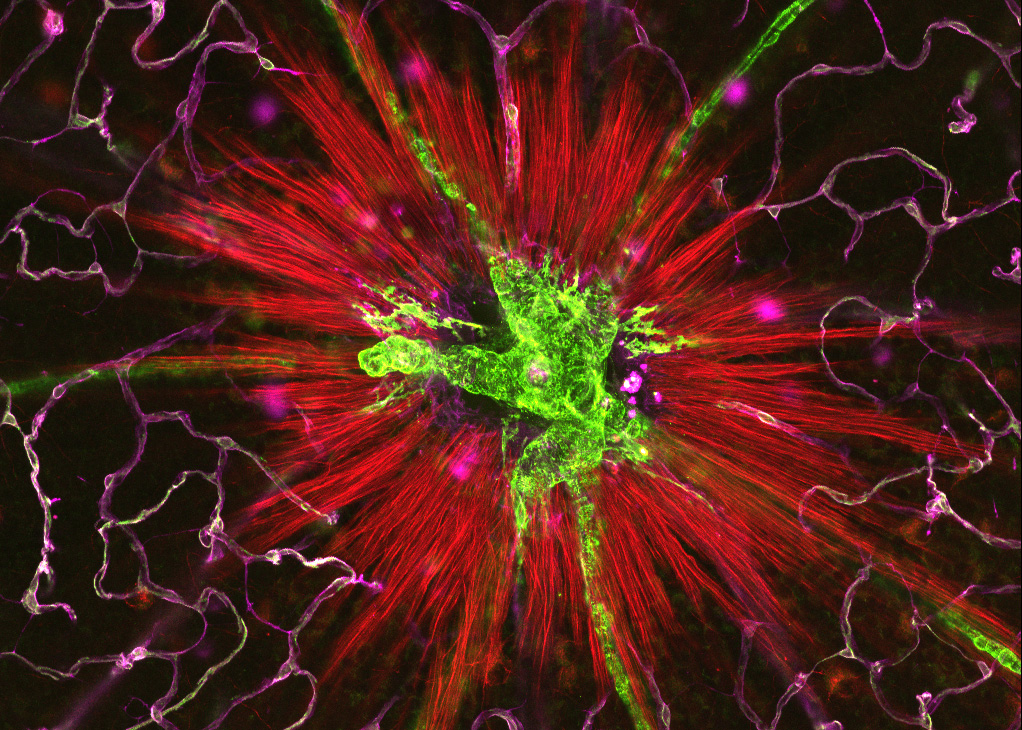
“We believe that the dysfunction found in blood vessels in glaucoma may be the result of tunnelling nanotubes breaking down – those that were once connected and coordinated optimal blood flow in the retina,” says Associate Professor Alarcon‑Martinez.
The discovery of nanotubes – small tubes connecting vessels in the eye – by a team of researchers which included Associate Professor Alarcon‑Martinez in 2020.
This has led to a focus on understanding what these structures are, and how they support the journey of blood through the eye.
“We believe that these tunnelling nanotubes could be a more fundamental cause of the interruptions and dysfunctions occurring in the blood that leads to cell death in the retina,” says Associate Professor Alarcon‑Martinez.
“This means that an important player in vision loss during glaucoma could potentially be the rupture of these tiny tubes.”
With the knowledge that these structures exist, the team are now looking to see exactly where and how these tiny vessels break down and how these might be the key to solving vision loss from glaucoma.
It’s time to get to work
“We now know that these tunnelling nanotubes exist, and we know that blood vessel dysfunction occurs early on in the disease process,” says Associate Professor Alarcon-Martinez.
“Now it’s time for us to get to work with the help of exciting new innovative technology to understand the exact mechanisms which cells in the retina communicate with one another to regulate blood supply.”
CERA is the only lab in Australia which can leverage a powerful two-photon microscope to allow visualisation of interpericyte tunneling nanotubes, blood flow and nerve cells in living tissue.
Its power enables Associate Professor Alarcon-Martinez and his team to recognise these tunnelling nanotube connectors which were once impossible to reach.
“Harnessing this technology could lead to us recognising and understanding the foundational cause of glaucoma and ultimately enable scientists to treat and prevent vision loss and blindness.”